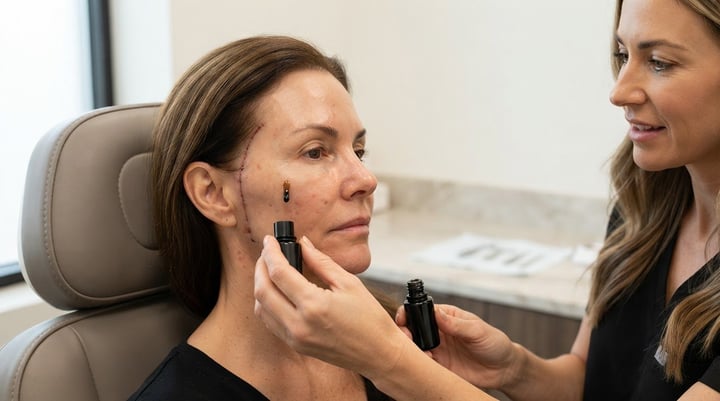

Kybella can reduce fat beneath the chin, but it does not dissolve scar tissue. If you are considering dissolving submental scar tissue after Kybella before a neck lift, first distinguish residual fat from tissue changes after treatment. The right approach depends on what is causing the fullness or firmness, not just how the area feels.
It is understandable to wonder whether a lump or uneven area means Kybella left fat behind or the treated area healed with firmness. These concerns matter when planning neck surgery, because fat, skin, and underlying tissue each affect the contour differently.
This guide explains what Kybella does, how a specialist assesses residual fat versus scar tissue, and what effects or treatment options to discuss before a neck lift. You will gain a clearer framework for understanding the area and planning your next step carefully.
Key Takeaways
- Kybella targets fat beneath the chin; it won’t dissolve scar tissue, so identifying what’s causing firmness is an important first step.
- Swelling, tenderness, bruising, and areas of hardness can occur after treatment, and their pattern over time helps frame what to discuss at an assessment.
- Know which symptoms may involve nerve changes or swallowing difficulty, and raise them when discussing your treatment history.
- Neck contour can be shaped by fat, loose skin, and muscle laxity, so the right approach depends on which structures are contributing.
- A necklift consultation can help connect your Kybella history and current concerns to a surgical plan suited to your neck’s tissue and contour.
Recovery, swelling, tenderness, and bruising
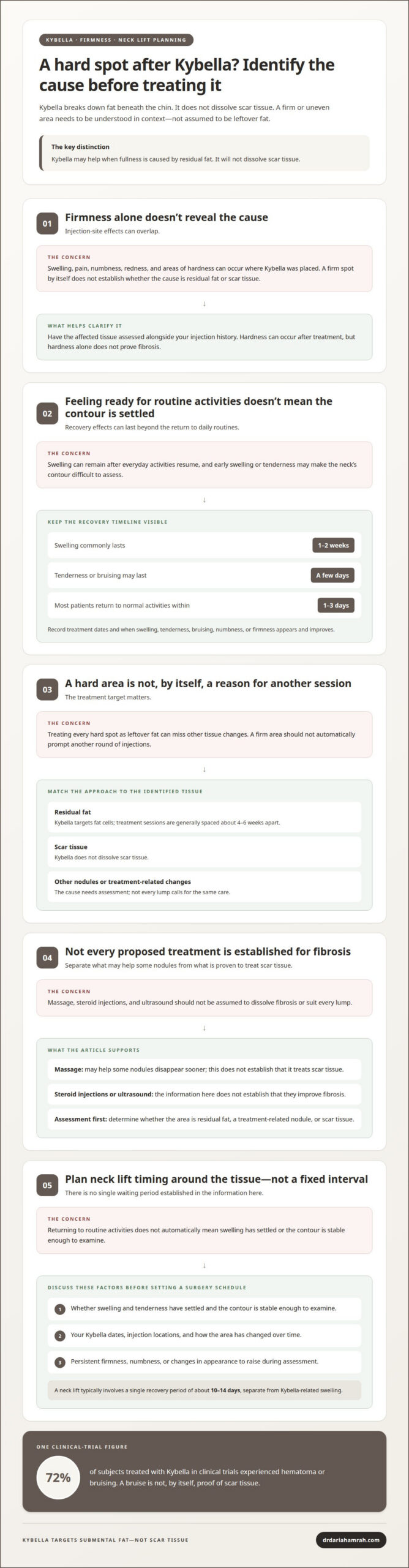
KYBELLA® is a prescription medicine approved for adults with moderate to severe fullness beneath the chin caused by submental fat. Its active ingredient, deoxycholic acid, breaks down fat cells; it doesn’t dissolve scar tissue. Swelling commonly lasts 1-2 weeks after treatment, while tenderness or bruising may last a few days. Most patients return to normal activities within 1 to 3 days, though swelling can remain after everyday routines resume.
That distinction matters when planning what comes next. Feeling ready for normal activities does not mean the neck’s contour is ready for assessment. Record treatment dates and changes, including when swelling, tenderness, bruising, numbness, or firmness appears and improves. For patients considering dissolving submental Kybella scar tissue before neck lift surgery, this timeline helps describe the concern without assuming the firm area is fat.
Follow the treating professional’s aftercare instructions. Kybella treatments are generally spaced about 4 to 6 weeks apart, but don’t assume another session is appropriate while the area remains swollen or difficult to assess. Kybella may help a hard area only when it comes from residual fatty deposits. It won’t dissolve scar tissue, so identifying the cause matters before considering further treatment.
How long should patients wait after Kybella before neck lift surgery? There is no single interval established by the information available here. Timing depends on whether swelling and tenderness have settled, the contour is stable enough to examine, and the treatment history, not simply on returning to routine activities. Share injection dates and any ongoing changes before setting a surgery schedule.
Does prior Kybella affect neck lift results, recovery, or complication rates? Prior treatment can affect what the surgeon sees during an examination, since swelling, bruising, tenderness, or firmness may obscure the contour. A treatment history alone does not establish a change in recovery or complication rates. Current tissue condition and the treatment timeline help guide planning for dissolving submental Kybella scar tissue before neck lift surgery.
How much does treatment for submental fibrosis or neck lift surgery cost in the United States? Cost depends on the condition being treated, the extent of surgery, and the plan required; pricing is provided after a quote request. A neck lift typically involves a single recovery period of about 10-14 days, separate from Kybella-related swelling.
What qualifications should a surgeon have to treat Kybella complications before a neck lift? Look for a board-certified facial cosmetic surgeon experienced in assessing facial and neck tissues and planning neck surgery. Bring your Kybella treatment timeline and describe persistent firmness, numbness, or changes in appearance. These details help the surgeon evaluate the treated area and discuss an appropriate next step.
Injection-site effects, including hardness and swelling
After KYBELLA® injections, swelling, pain, numbness, redness, and areas of hardness can occur where the medicine was placed. These effects can overlap, so a firm spot alone does not establish whether the cause is residual fat or scar tissue.
Treatments for Kybella-Related Fibrosis
There is no single treatment for every post-injection lump. First, distinguish a remaining fatty deposit from scar tissue: Kybella may help if the hardness is caused by residual fat, but it will not dissolve scar tissue. Before a neck lift, this distinction helps shape a plan around the tissue present and the contour the procedure needs to address.
What causes fibrosis or scar tissue after Kybella injections under the chin? Areas of hardness can occur after Kybella injections, but hardness alone does not prove fibrosis. The specific cause needs to be assessed in the context of the injection history and the affected tissue.
The injection procedure uses multiple placements under the chin to target submental fat. Treatment sessions are spaced about 4 to 6 weeks apart. Because injection patterns and the treated area affect what a clinician later observes, record where the injections were placed, when they occurred, and how the area changed. This timeline can help distinguish an ongoing treatment response from a persistent contour concern.
Discomfort, bruising, and swelling can also make the area feel uneven. Hematoma or bruising occurred in 72% of subjects treated with Kybella in clinical trials. A bruise is not itself proof of scar tissue, and a hard area should not automatically prompt another round of injections. Assessment should focus on the cause of the contour change.
Steroids, Massage, and Ultrasound
Massage may help some nodules disappear sooner, but that does not establish that it treats scar tissue. Steroid injections and ultrasound should not be assumed to dissolve fibrosis or suit every lump. The key is to determine whether the area is residual fat, a treatment-related nodule, or scar tissue, then select care accordingly.
Can steroid injections, massage, or ultrasound improve Kybella lumps or fibrosis? Massage may help some nodules resolve, while Kybella targets residual fat rather than scar tissue. The information here does not establish that steroid injections or ultrasound improve fibrosis, so they should not be presented as proven solutions.
What treatments are used for Kybella-related submental fibrosis before a neck lift? The approach depends on what examination identifies: Kybella may address residual fat, but it doesn’t dissolve scar tissue. A neck-lift plan should account for the area’s tissue and contour rather than treating every hard spot alike. A focused facial assessment can help organize those considerations before surgery.
Potential nerve injury and swallowing difficulty
Kybella contains deoxycholic acid, which targets fat beneath the chin, including fullness sometimes called a double chin. Injection placement matters because nerves and muscles also occupy the facial and neck region. Clinical trial safety data reported marginal mandibular nerve injury in 4% of treated patients, with effects such as an asymmetrical smile or facial muscle weakness.
These considerations make an accurate treatment history important before cosmetic surgery. Share the number and timing of Kybella sessions, the amount of product used if known, and any facial changes after injections. Include symptoms such as an uneven smile, weakness, bruising, or difficulty swallowing. A treatment record helps the surgeon interpret the area rather than treating every contour difference as remaining fat.
Difficulty swallowing, also called dysphagia, occurred in 2% of subjects in Kybella clinical trials. Reported cases resolved spontaneously within 1-81 days, with a median of 3 days. That range describes trial cases, not a schedule for an individual patient. Persistent or recurring swallowing difficulty belongs in the treatment history and should be discussed before planning a neck procedure.
What are the risks of operating on scarred tissue after Kybella? Scarred or firm tissue can make it harder to assess the neck’s layers and distinguish fibrosis from residual fat. This can affect surgical planning, so the surgeon needs to know where and when injections occurred and what changes followed.
Marginal mandibular nerve effects were reported to resolve spontaneously in all reported Kybella-associated cases, with resolution ranging from 1-298 days and a median of 44 days. The range shows why a single recovery timeline shouldn’t be assumed. A change in smile or facial muscle strength after treatment is relevant even if it later improves; document when it began and whether it changed.
Liposuction and Kybella address superficial neck fat, but neither fact explains every post-treatment lump or symptom. Nerve-related changes and difficulty swallowing are different concerns from residual fullness. Before setting a cosmetic plan, an examination should consider the symptoms’ location and timing and the area treated.
Before a neck lift, organize the details into a concise timeline: Kybella treatment dates, injection areas, when symptoms began, and whether each symptom improved or persisted. Include prior evaluations or treatment records when available. This helps the surgeon assess tissue condition and facial movement together, rather than relying only on visible fullness beneath the chin.
Avoid alcohol for a week before Kybella treatment because it may increase the risk of bruising. If alcohol use is relevant to treatment planning, mention it when discussing the procedure and any bruising concerns with the clinician. Including this precaution with your injection history can make the conversation more complete before treatment.
Neck contouring surgery and other alternatives
Choosing between further Kybella sessions and surgery starts with identifying what is causing the neck’s fullness. The neck has two fat compartments, one above and one below the platysma muscle. Kybella and liposuction treat only the superficial compartment. If excess skin or muscle laxity affects the contour, reducing superficial fat alone may not address the concern.
Kybella is intended for submental fullness caused by fat, not loose skin or muscle laxity. It may involve up to 6 treatments, so the decision to continue should account for the remaining fullness and the tissue causing it. A hard area isn’t automatically residual fat; treating scar tissue as fat could lead to more injections without addressing the actual concern.
For someone considering surgery, the examination should connect the visible contour to its likely cause. A plastic surgeon considers the skin, superficial fat, platysma, and any injection history. This matters especially when fullness appears beneath the muscle, since superficial treatments do not reach that compartment. The location and quality of the tissue help shape the surgical discussion.
Significant excess skin may make options such as a face or neck lift more suitable than Kybella. A neck lift is worth discussing when loose skin or muscle laxity contributes to the concern, rather than fullness caused only by superficial fat. The treatment choice should reflect the structures affecting the profile, not simply the number of prior Kybella sessions.
- Superficial fat: Kybella or liposuction targets the fat above the platysma.
- Loose skin: A face or neck lift may be considered when excess skin is significant.
- Fat below the platysma: The surgical plan may need to address the deeper compartment; platysmaplasty is also required when fat is removed from underneath the platysma.
These distinctions are especially relevant before a neck lift after Kybella. Bring your treatment timeline and point out where fullness or firmness remains. The surgeon can assess whether the contour reflects fat, skin, muscle, or a combination. That evaluation helps determine whether further nonsurgical treatment or surgery better fits the concern.
Recovery also differs by approach: a neck lift or liposuction typically involves a single recovery period of about 10-14 days. By comparison, Kybella is delivered in separate sessions, with treatments spaced about 4 to 6 weeks apart. Considering the treatment pattern alongside the tissue findings helps frame the practical trade-offs of ongoing injections versus surgery.
Patients with significant excess skin may be better suited to alternatives such as liposuction, ThermiRF, or a face or neck lift instead of Kybella. Kybella is the only injectable treatment approved by the FDA to permanently destroy fat cells under the chin. Patients younger than 50 do not require skin removal in the described neck-fat procedures. A study analyzing patient reviews reported an 83.4% satisfaction rate for submental liposuction patients, and submental liposuction is described as taking a single hour. These details can help frame a discussion, while the appropriate option depends on the tissue contributing to the contour.
Distinguishing scar tissue from residual fat
A firm area under the chin after Kybella can have more than one explanation. Distinguishing residual fat from scar tissue matters because Kybella targets fat, not fibrosis.
Assessing Fibrosis Before Surgery
At a consultation, a facial plastic surgeon considers your injection history alongside the current contour and tissue. The location of firmness, when it appeared, and whether it changed as swelling settled all provide context. For example, a persistent hard area and a soft pocket of fullness should not automatically be treated as the same concern.
How do plastic surgeons evaluate submental fibrosis before neck lift surgery? They consider treatment dates, injection areas, symptom changes, and the tissue’s appearance and feel during examination. Bring prior treatment records and describe specific changes, such as a lump that remained after swelling improved.
Kybella sessions are spaced over time, so the treatment timeline can help clarify what happened after each one. Record when injections occurred and whether firmness changed between sessions. A hard sensation alone cannot identify the tissue causing it. This distinction is central when considering dissolving submental Kybella scar tissue before a neck lift, because the underlying cause determines whether Kybella is relevant.
Addressing Scar Tissue Before a Neck Lift
Can Kybella-treated submental scar tissue be dissolved or broken up before a neck lift? Kybella may help hard areas only when they are residual fatty deposits; it does not dissolve scar tissue. If you are considering dissolving submental Kybella scar tissue before a neck lift, first clarify whether the firmness is fibrosis or remaining fat, rather than assuming another injection will address it.
There is no single approach for every area of submental fibrosis. The decision depends on what the examination finds and how the tissue relates to the planned neck lift. Do not treat an unexplained lump as fat. The distinction guides discussion of an appropriate plan before surgery.
Prepare a concise timeline for your consultation. Include Kybella injection dates and areas, when each lump or contour change appeared, and whether it grew, softened, or remained. If sessions were spaced over time, note changes between them rather than describing only the latest appearance.
Describe the concern in practical terms, such as whether fullness is visible at rest, noticeable from the side, or limited to a small firm spot. Those details help connect the physical finding to your desired contour. Arrange a neck contour consultation to discuss the findings before surgery.
Dr. Daria Hamrah: Necklift
Dr. Daria Hamrah’s Necklift is a next step when excess skin or muscle laxity contributes to neck fullness after Kybella. A focused surgical consultation can consider your treatment history, current tissue, and desired contour together, helping clarify whether a neck lift fits your concern.
Bring the dates of your Kybella sessions and note any lasting firmness, swelling, or changes in facial movement. These details help inform an assessment of the area before surgical planning. Kybella reduces fat, but it does not dissolve scar tissue, so understanding what shapes the contour is central to choosing an approach.
If you are considering a neck lift after Kybella, contact Dr. Daria Hamrah to discuss your concerns and next steps.
Make Your Next Decision With Clarity
Planning to address submental scar tissue after Kybella before a neck lift starts with understanding what shapes your contour and what outcome matters to you. Use your consultation to discuss your priorities, treatment history, and recovery concerns. The right plan depends on the tissue findings and your goals, not a one-size-fits-all approach.
Dr. Daria Hamrah’s broader facial aesthetic practice also includes the Deep Plane Facelift (Longevity Facelift), rhinoplasty, and Botox. These options address different concerns, while a neck-focused assessment keeps the conversation centered on your individual needs.
Bring up any questions that remain unresolved. A thoughtful discussion can help you understand the available options and decide what feels appropriate for your next step.
Contact Dr. Daria Hamrah to discuss your concerns and move forward with greater clarity.
Frequently Asked Questions
What is Kybella?
Kybella is a prescription medicine for adults that improves the appearance and profile of moderate to severe fat beneath the chin. Its active ingredient, deoxycholic acid, helps break down dietary fat and is used to target submental fat cells. It addresses fullness caused by fat, not every cause of a heavier-looking neck. Skin laxity or muscle changes call for a different assessment.
What Should I Expect During the Treatment?
A treatment involves multiple injections beneath the chin, with the placement and amount tailored to the area being treated. There may be more than one session, and changes develop gradually rather than immediately. It can take weeks to see visible improvement, with maximum results taking up to 12 weeks. Plan around this gradual progression when assessing changes in your profile.
Does it hurt?
Pain or discomfort can occur during or after Kybella injections. The experience varies, and the area may also feel tender, numb, or swollen afterward. Tell the treating professional about discomfort during the procedure and follow their aftercare instructions. If you notice new difficulty swallowing or facial weakness, report those symptoms promptly rather than treating them as routine injection discomfort.
Who is a candidate?
Kybella is intended for adults with moderate to severe fullness beneath the chin caused by fat. It may be less suited to concerns driven mainly by loose skin or muscle laxity, since it does not address those structures. A useful starting point is determining whether fat is the primary source of fullness. Treatment history and the contour you want to improve also inform the discussion.