Can a scar cream be helpful yet still be too harsh for healing skin? Retinol for post-surgery skin is a matter of timing: after skin cancer surgery, wait until the skin has fully re-epithelialized before restarting topical retinoids. Applying an active ingredient to an unclosed wound can interfere with recovery.
It’s understandable to look for a topical treatment that may soften a scar’s appearance. Retinoids can affect collagen-related changes in skin, but they don’t replace careful wound care. Starting too soon can irritate vulnerable tissue.
This guide explains how to recognize when skin may be ready for retinoids, how to reintroduce them gradually, and what they may contribute to collagen and scar appearance. The right approach depends on the procedure, the condition of the incision, and your skin’s response, so your routine should support healing rather than compete with it.
Key Takeaways
- After skin cancer surgery, wait until the skin has fully re-epithelialized before restarting topical retinoids.
- Reintroduce retinoids gradually, allowing time to see how your skin responds before increasing application frequency.
- Retinoids may support collagen production and influence the appearance of scars, but results depend on more than a topical product alone.
- Watch for irritation, dryness, redness, or flaking, which can be harder on skin that’s still healing.
- Build scar care around gentle skin support and sun protection, and learn which products may fit different stages of recovery.
When to restart topical retinoids after surgery
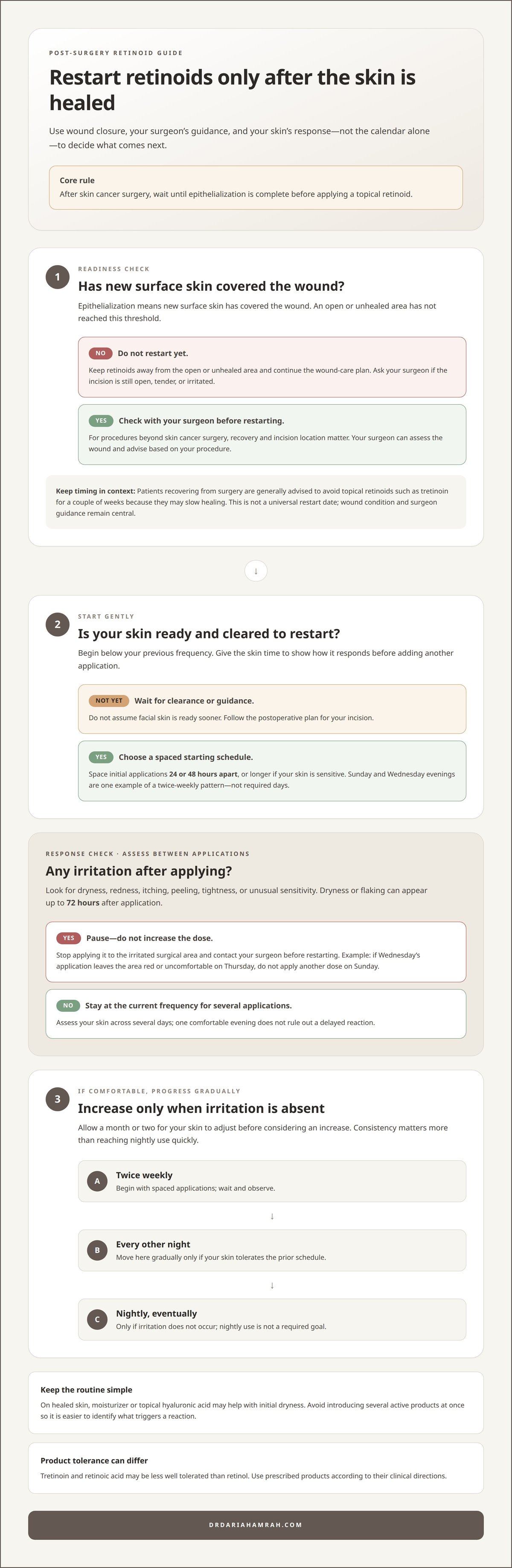
Restart timing depends on the procedure and wound condition, not simply the calendar. After skin cancer surgery, wait until epithelialization is complete before applying a topical retinoid.
Restart timing and surgeon guidance
Epithelialization means new surface skin has covered the wound. After skin cancer surgery, wait until this process is complete before using retinoids. For other procedures, recovery and incision location matter, so the date alone can’t establish readiness.
Ask your surgeon before restarting, especially if the incision is still open, tender, or irritated. Patients recovering from surgery are generally advised to avoid topical retinoids such as tretinoin for a couple of weeks because they may slow healing. Your surgeon can assess the wound and advise you based on the procedure.
Retinol use doesn’t follow a separate rule for facial surgery versus other procedures: wound closure and healing remain central. Facial incisions may sit in sensitive or visible areas, so follow the specific postoperative plan rather than assuming facial skin is ready sooner.
Risks to healing surgical skin
Retinoids can irritate skin through dryness, redness, itching, and peeling, effects that may complicate care around a healing incision. A porcine-model study found that tretinoin 0.05% applied daily for 10 days before partial-thickness skin wounding sped re-epithelialization, while use after wounding slowed healing.
That finding doesn’t establish a restart schedule for every procedure. It does show why applying an active ingredient to a fresh wound is different from using it on intact skin. If the incision still needs wound care, keep retinoids away until it reaches the healing threshold set for your procedure.
Gradual retinol reintroduction
Once your surgeon says the skin is ready, restart slowly rather than returning immediately to nightly use. Space initial applications 24 or 48 hours apart, or longer if your skin is sensitive; Sunday and Wednesday evenings are one example of a twice-weekly schedule.
After starting, allow a month or two for your skin to adjust before increasing frequency. If irritation doesn’t occur, move gradually toward every other night and, eventually, nightly use. Dryness or flaking can appear up to 72 hours after application, so assess your skin across several days before adding another application.
For example, if applying retinol on Wednesday leaves the incision area red or uncomfortable on Thursday, don’t apply another dose on Sunday. Pause and seek guidance about the symptoms and wound before continuing. Reintroduce retinoids gradually only after the skin has fully healed, and follow your surgeon’s advice on timing.
Gradually increasing application frequency
After the incision has healed and you’re cleared to restart, build retinoid use gradually instead of returning to your previous routine. A measured schedule helps you notice irritation before repeated applications place more stress on recovering skin.
Start with applications spaced 24 or 48 hours apart, or longer if your skin is sensitive. For example, Sunday and Wednesday evenings provide two weekly application nights with recovery time between them. This is a starting pattern, not a requirement to apply retinol on those exact days. Keep the product away from any area that remains open or unhealed, and follow your surgeon’s wound-care instructions.
Hold that frequency for several applications before considering an increase. Retinol-related dryness or flaking may not appear until 72 hours after application, so the skin can seem comfortable at first and react later. Don’t add another application simply because the first evening passed without redness. Look at the full response between uses, including whether the treated area feels tight, itchy, or unusually sensitive.
If your skin tolerates the initial schedule, increase use step by step: twice weekly, then every other night, and eventually nightly only if irritation doesn’t occur. It may take a month or two to adjust to retinol without dryness, so there’s no need to rush. Tretinoin and retinoic acid may be less well tolerated than retinol; use prescribed products according to their clinical directions.
If retinol irritates a healing surgical area, stop applying it there and contact your surgeon before restarting. Redness, itching, peeling, or dryness can signal irritation. Symptoms around an incision deserve attention, not a dose increase.
To ease initial dryness on healed skin, moisturizer or topical hyaluronic acid may help. Avoid introducing several active products at once, so it’s easier to identify what causes a reaction. For example, if you increase retinol use and add an exfoliating product in the same week, you may not know which change triggered irritation.
Track application nights and skin responses for the first month or two. If discomfort starts after an increase, return to the last comfortable frequency only when the surgical area has settled and your surgeon’s instructions allow it. Consistency matters more than reaching nightly use quickly.
Retinoids and collagen production
Retinoids are vitamin A derivatives that can influence skin-cell activity and collagen production. Collagen provides structural support in skin, so changes in its production may affect texture and the appearance of some scars. Retinoids are a gradual skin treatment, not a way to close a surgical wound or replace postoperative care.
Retinoids are reported to stimulate skin-cell metabolism and encourage collagen production, including types 1 and 3. These effects help explain why topical retinoids are studied for skin changes and scars. They don’t mean every scar responds in the same way: scar type, location, age, and the condition of the surrounding skin all matter.
Research on acne scars illustrates the difference between a potential benefit and a guaranteed outcome. In a study of 60 patients with atrophic acne scars, tretinoin cream was used once daily for six months. Atrophic scars involve areas of depressed skin. That study provides context for tretinoin as a scar treatment, but it doesn’t establish the same effect for a fresh surgical incision.
Other studies have examined different scar types and treatment schedules. A randomized controlled trial applied topical tretinoin to hypertrophic scars twice daily for six months. A separate study of 20 patients with keloids used topical tretinoin twice daily for 24 weeks. Hypertrophic scars and keloids are raised scars, so those findings shouldn’t be treated as interchangeable with results for atrophic scars.
Timing is essential after surgery. Collagen-related effects develop over time, while a new incision first needs to heal. Don’t apply retinoids to an open or incompletely healed wound for a possible scar benefit. Once the surface has healed and you’re cleared to use them, consistent application may be part of a scar-care plan.
Keep expectations realistic about topical treatments. Retinoids may influence texture, tone, and collagen activity, but findings from studies of acne scars or raised scars don’t prove retinol will erase a surgical scar. A scar’s appearance changes as it matures, and its response depends on the scar and surrounding skin.
For a practical approach, first identify the concern: a depressed mark, a raised scar, or discoloration around a healed incision. Then consider the retinoid, schedule, and skin tolerance separately. The studies above used tretinoin, not every over-the-counter retinol product, so don’t automatically copy their schedules. Follow your postoperative instructions and use retinoids only on healed skin.
What risks can retinol pose to healing surgical skin?
Retinol can irritate skin, which matters when an incision is still healing. Dryness, redness, itching, peeling, and flaking can cause discomfort and complicate routine wound care. Topical retinoids, including tretinoin, are generally avoided for a couple of weeks after surgery because they may slow healing.
Timing can change the effect. In a porcine-model study, tretinoin 0.05% applied daily for 10 days before partial-thickness skin wounding sped re-epithelialization. Applying it after wounding slowed healing. This animal-model finding doesn’t set a schedule for every human operation, but it highlights why a fresh wound differs from intact skin.
Retinoid irritation can also be delayed. Dryness and flaking may not appear until 72 hours after application, so a comfortable first evening doesn’t rule out a later reaction. For example, someone may apply tretinoin on Monday and notice tightness or peeling on Thursday. That delay makes it easy to apply another dose before the skin’s response is clear.
Retinoic acid is less well tolerated than retinol and may cause irritation, itching, peeling, or redness. Tretinoin cream used for scars can also cause photosensitivity, erythema, dryness, and flaking. Erythema means skin redness; photosensitivity means increased sensitivity to sunlight. Around a surgical area, irritation can add discomfort while the skin recovers.
Watch for changes after each application, rather than judging tolerance only by how the skin looks immediately afterward. A useful record includes the application day, the product used, and any reaction over the following 72 hours. If redness, itching, or peeling appears near an incision, stop applying the retinoid to that area and contact the surgeon for direction.
- Dryness or flaking: note when it begins, including reactions appearing days after application.
- Redness or itching: avoid applying another dose to irritated surgical skin.
- Sun sensitivity: protect treated skin from sun exposure, especially when using tretinoin.
A retinoid’s effects on intact skin don’t make it suitable for an unhealed wound. After skin cancer surgery, wait until epithelialization is complete before using topical retinoids. In practice, a closed, healed surface can be treated differently from a wound that still needs protection and care.
Consider these potential effects together: photosensitivity, erythema, dryness, and flaking are all common potential side effects of tretinoin cream used for scars. They can help describe how the skin is responding, but not everyone will experience them, or experience them at the same time. Keeping track of the product and reaction can make it easier to discuss the response with your surgeon.
What ingredients or products are safe for post-surgery skin care?
After surgery, match skin care to the wound’s stage of healing. A closed incision and an open wound need different approaches, so don’t apply active products to a wound that still needs postoperative care. For retinol for post-surgery skin care, follow your procedure’s instructions before adding retinoids, sunscreen, or silicone scar products.
For dryness on healed skin, moisturizer or topical hyaluronic acid may help with comfort. If you’re restarting retinol, mixing it with moisturizer is one suggested way to reduce its drying effect. Apply gently and don’t rub product into the incision. A simple routine also makes it easier to identify ingredients that cause irritation.
Sun protection is part of scar care because sun exposure on an immature scar can cause hyperpigmentation. Use broad-spectrum, high-SPF sunscreen daily when using a retinoid during summer, and reduce direct exposure by avoiding peak sun hours and wearing a broad-brim hat outdoors. After skin surgery, avoid chemical sunscreens for 4 weeks because they’re more likely to cause allergic contact dermatitis.
Silicone sheets or gel, retinoic acid, and sun protection may be combined in a scar-care protocol. Each serves a different role, so one doesn’t replace the others. Retinoic acid is prescription-only, and tretinoin cream should be used cautiously with medical guidance. A scar protocol may not be appropriate while the wound remains open.
Some scar protocols describe beginning with retinoic acid at 0,025% and using 0,050% while the scar matures for one year. Those concentrations and duration describe a specific approach, not a universal routine for every surgical scar. Product strength, scar condition, skin tolerance, and healing stage all shape how a topical plan is used.
Rhinoplasty can involve a distinct skin consideration: isotretinoin derivatives may be used for very oily, sebaceous skin after surgery to help the skin mature and adapt to the underlying framework. This isn’t a general recommendation for every rhinoplasty patient. Skin type and the recovery plan guide whether this approach fits.
Keep wound care and scar care distinct. During healing, use only products included in your postoperative instructions; after the surface has closed, scar care can be considered in context. A retinol for post-surgery skin routine should reflect your recovery stage and skin response. For guidance on a routine that accounts for your skin and recovery, explore personalized skin-care guidance.
Dr. Daria Hamrah: Medical-grade Skincare
Dr. Daria Hamrah offers Medical-grade Skincare for patients seeking a considered approach to skin health after recovery. If you’re deciding how retinoids fit into scar care, a skincare plan can align product use with your skin’s condition and goals. Wait until the surgical area has healed and your postoperative instructions allow active treatments.
For concerns beyond a topical routine, Laser skin treatments may be relevant to broader skin goals. The appropriate option depends on the concern and your recovery stage, rather than a one-size-fits-all routine.
Contact Dr. Daria Hamrah for guidance on skin care or treatment options.
Make your next step part of a thoughtful care plan
A thoughtful approach to retinol for post-surgery skin can be part of a wider conversation about recovery and long-term skin goals. Rather than treating a topical product as a stand-alone fix, consider how your routine fits the changes you want to support and the care you’ve already received.
Dr. Daria Hamrah offers Medical-grade Skincare alongside facial procedures and treatments, including the Deep Plane Facelift (Longevity Facelift), Rhinoplasty, and Botox. These options address different concerns, so the right conversation starts with your priorities, whether you want to refine a skincare routine or explore broader facial rejuvenation.
If you’d like advice on your next step, contact Dr. Daria Hamrah for advice. A considered plan can help you move forward with clarity and confidence.
Frequently Asked Questions
Do topical creams, gels or pads work to decrease scarring?
Some topical products may improve aspects of a scar’s appearance, but no cream, gel, or pad can be expected to erase every scar. Silicone sheets or gel are sometimes combined with retinoic acid and sun protection in scar-care protocols. The best fit depends on whether the scar is raised, indented, or discolored, and whether the skin has healed enough for those products.
What are retinoic acid and all vitamin A derivatives used for?
Vitamin A derivatives include retinol and prescription retinoic acid, also called tretinoin. These topical ingredients are used for different skin concerns, including changes in texture, tone, and the appearance of some scars. Retinoids may encourage collagen production, including types 1 and 3. Their strength and tolerability vary, so a product used for general skin care isn’t automatically suitable for a surgical scar.
Can you use retinol on skin after surgery?
Yes, retinol may be used on skin after surgery once the treated area has healed and postoperative instructions allow it. Don’t apply it to an open incision or wound. For example, if nearby skin is intact but the incision is still healing, keep retinol away from the incision and follow the wound-care plan. If irritation develops, stop applying it to the affected area.
How long after surgery should you wait before using retinol?
There isn’t one waiting period for every operation. Patients recovering from surgery are generally advised to avoid topical retinoids for a couple of weeks, while skin cancer surgery requires waiting until epithelialization is complete. This means new skin has closed over the wound. A calendar interval alone doesn’t establish that an incision is ready for retinol.
When is it safe to apply retinol near a surgical incision?
Apply retinol near an incision only after the skin has healed and your postoperative instructions permit it. Keep in mind that a product can spread beyond where you apply it, so don’t let it reach an open or irritated wound. For example, apply it only to healed skin away from the incision until your surgeon’s guidance allows use closer to it.
Does retinol affect scar healing or scar appearance after surgery?
Retinol may influence collagen activity and the appearance of healed skin, but applying a retinoid too soon can irritate the area and may interfere with healing. Potential scar benefits don’t mean it should go on a fresh incision. Consider the scar type, skin tolerance, and whether the surface has healed. Studies involving acne or raised scars don’t establish the same results for every surgical scar.