A tighter pull on the skin can make a facelift look less natural. Why skin-only facelifts fail and create stretched scars often comes down to where the lift is applied: tightening skin without repositioning deeper facial tissues can place excess tension on incision lines while leaving underlying contours unsupported. Deep plane techniques reposition deeper facial tissue instead of relying on taut skin, which can support a more balanced result.
It’s reasonable to care about both how a facelift looks and how its scars heal. The method matters, as do the areas treated, tension on the skin, and your body’s healing response. Understanding how these factors affect scar widening, facial contours, and the longevity of results can help explain why a natural-looking lift depends on more than removing loose skin.
Key Takeaways
- Natural-looking results depend on repositioning deeper facial tissues, not simply pulling the skin tighter.
- Excess tension at incision lines can contribute to scars that widen, thicken, or become more visible as they heal.
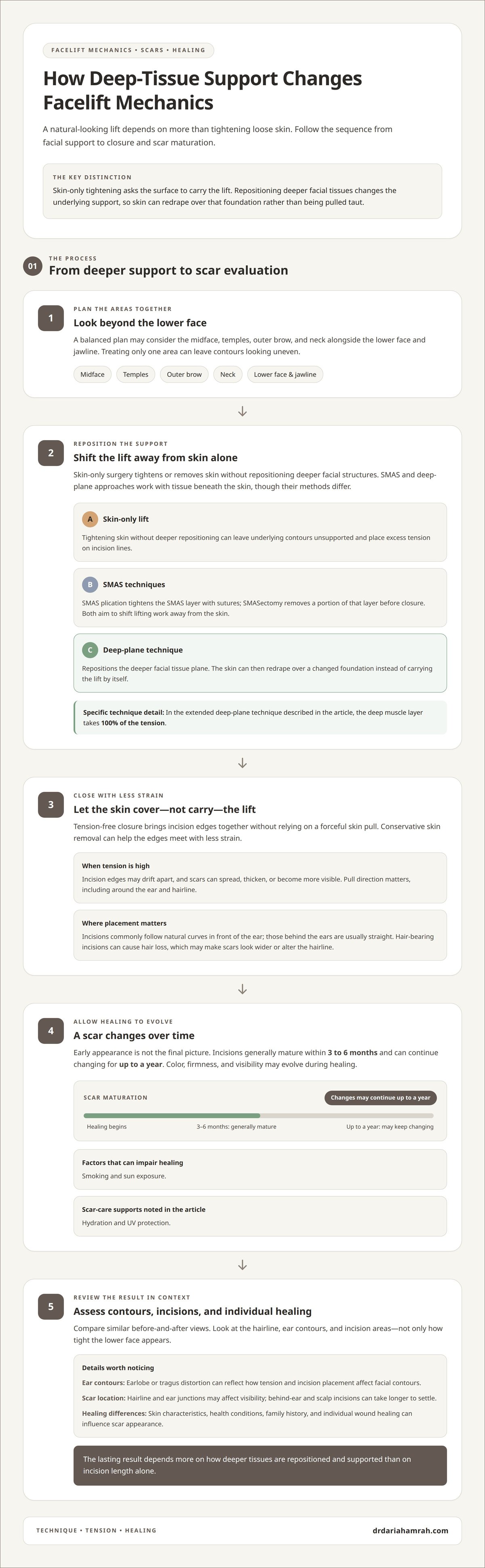
- A balanced facelift considers the midface, temples, outer brow, and neck, as well as the lower face and jawline.
- Changes around the ear, including earlobe or tragus distortion, can reveal how tension and incision placement affect facial contours.
- Scar maturation takes time, and lasting results depend more on how deeper tissues are repositioned and supported than on incision length.
Do deep plane facelifts look more natural?
Facelift results can look more natural when deeper facial tissues are repositioned instead of relying on skin tension. The distinction affects facial contours, how the skin settles, and how much strain reaches the scars.
Deep-Plane Facelift Mechanics
A skin-only facelift tightens or removes skin without repositioning deeper facial structures. SMAS and deep-plane techniques work with tissues beneath the skin. With a deep-plane facelift, the surgeon repositions the deeper facial tissue plane, supporting rejuvenation without pulling the skin taut. The skin can then redrape over a changed foundation rather than carry the lift by itself. This helps explain why skin-only facelifts fail and create stretched scars when deeper support is left unaddressed.
Tension-Free Skin Closure
Tension-free closure means bringing incision edges together without relying on a forceful skin pull to hold the lift. SMAS plication tightens the SMAS layer with sutures, while SMASectomy removes a portion of that layer before closure; deep-plane surgery repositions deeper tissues. These approaches differ, but each aims to shift lifting work away from the skin. In the extended deep-plane technique described, the deep muscle layer takes 100% of the tension. Conservative skin removal can help the edges meet with less strain.
Natural-Looking Results and Scars
A natural-looking result depends on balanced contours, not simply a tighter surface. Repositioning deeper tissue can avoid the pulled appearance that may follow skin tightening without structural support. Incision tension also matters: high tension can contribute to scars that spread or thicken early after surgery. Facelift scars continue to soften and lighten during months 3-12; for most patients, they become difficult to find in ordinary conversation. Healing varies, so scar appearance reflects both technique and individual wound healing.
Before-and-after photos can help you assess whether results preserve natural facial character. Compare similar views and look closely at the hairline, ear contours, and incision areas. Revision rates need context, too: they’re more informative when the definition of revision and the types of cases included are clear. These details can help distinguish a refined lift from one that looks pulled or leaves noticeable scars.
Incision Locations and Scar Visibility
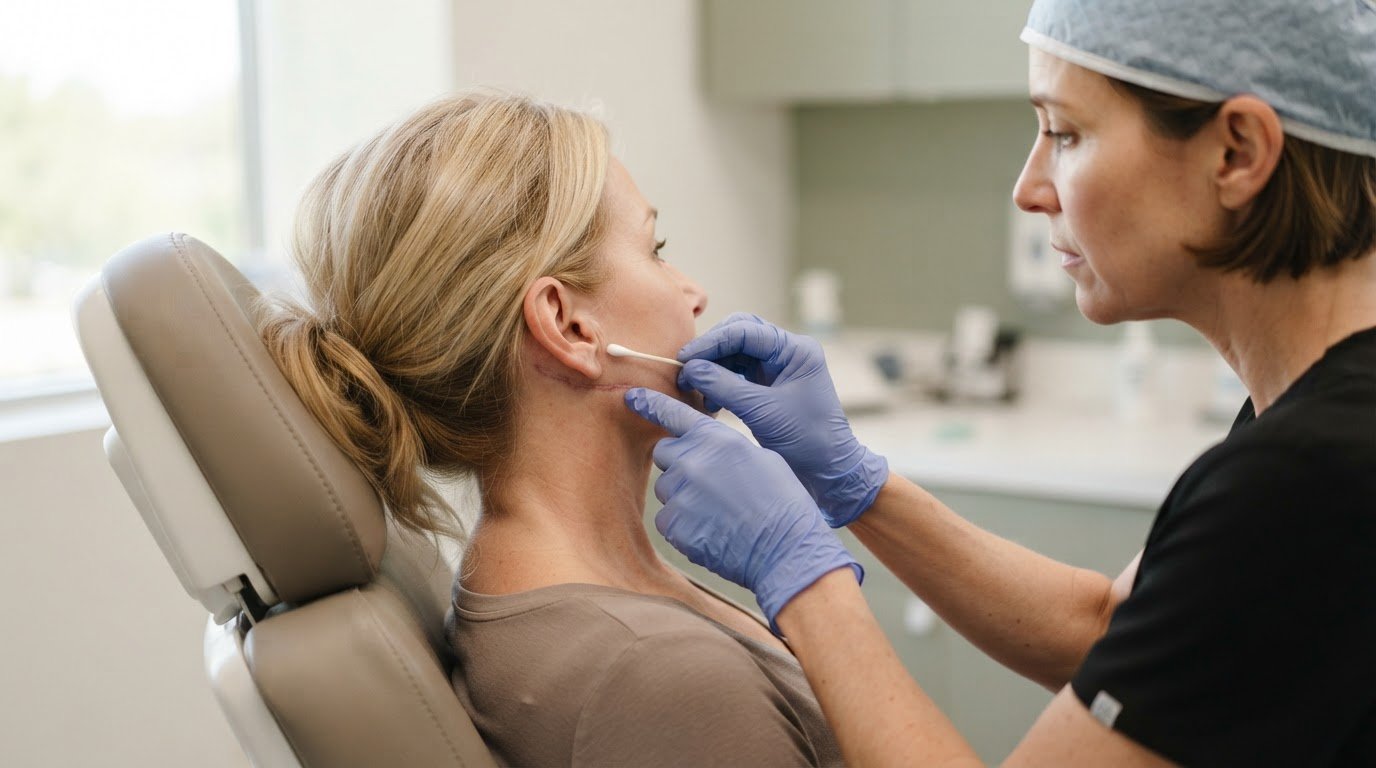
Facelift incisions commonly follow natural curves in front of the ear, while incisions behind the ears are usually straight. Placement matters because scars may be visible where they meet the hairline or ear. Incisions in hair-bearing areas can cause hair loss, making scars look wider and potentially altering the hairline. Incisions behind the ears and in the scalp can also take longer to settle than more visible facial incision lines.
Scar changes take time to interpret. Incisions generally mature within 3 to 6 months after surgery and can continue changing for up to a year. During that period, a scar’s color, firmness, and visibility may evolve. Looking at healed results alongside early healing photos gives a fuller picture of how incision placement and tension affect the final appearance.
How skin tension can widen facelift scars
Tension on an incision affects how a facelift wound heals and how noticeable its scar may become. The direction and amount of pull, including around the ear and hairline, shape the forces acting on healing skin.
Tension in Scar Formation
Skin tension is the pulling force across an incision as its edges heal. Sustained force can make a scar spread. When a facelift incision is closed under substantial tension, its edges may drift apart, thicken, or widen early after surgery. Imagine a seam pulled from both ends: the skin has to heal while resisting that force. Lower tension gives the wound edges a better chance of staying aligned.
Excessive Tension on Skin
Excessive tension occurs when skin is expected to carry too much of the lift instead of simply covering repositioned tissue. During closure, conservative skin removal can help the edges meet without forceful pulling. This matters near the ear, where excess skin bunching behind it can contribute to a more noticeable scar. A smooth, tension-conscious closure considers how the incision lies, not just how much skin is removed.
The amount of pull is only part of the picture. Its direction matters, too. A facelift that pulls skin horizontally toward the ears can strain the incision line, particularly where the skin is secured around the ear. If the incision is also placed in a hair-bearing area, hair loss can make the scar look wider and alter the hairline. These effects can change the appearance even when the incision follows a discreet route.
Tension and Scar Visibility
Scar visibility describes how clearly an incision stands out because of its width, color, or position. Tension can influence each feature as healing progresses. High tension can contribute to poorer wound healing and more visible scars. Skin characteristics, health conditions, or family history can also affect a scar, independently of the technique used. That’s why incision appearance reflects more than the cut alone.
In the weeks after surgery, a scar’s early appearance doesn’t tell the whole story. Incisions generally mature within 3 to 6 months after surgery and continue changing for up to a year. Smoking and sun exposure can impair wound healing, while hydration and UV protection support scar care during recovery. If an incision appears to widen or thicken, its location, tension, and healing changes all help explain what may be contributing to its appearance.
Treating the midface, temples, outer brow, and neck
A facelift plan affects more than the lower face: untreated areas can leave facial contours looking uneven. Considering the midface, temples, outer brow, and neck alongside the jawline helps clarify which concerns surgery addresses and which may call for different treatments.
Traditional facelift techniques often focus on the lower face and jawline, pulling skin horizontally toward the ears. They may leave the midface, temples, and outer brow untreated. For example, the jawline may look firmer while sagging in the midface or heaviness near the outer brow remains. Treating the face without addressing the neck can also make the overall result appear incomplete. This is why facial rejuvenation planning considers areas together, rather than judging a lift by one contour alone.
Facial cosmetic surgery can address distinct goals: repositioning facial tissues, improving skin texture, or treating scar color and thickness. A surgical lift changes tissue position; laser treatment may be considered for scar appearance. These approaches aren’t interchangeable. A laser doesn’t reposition deeper facial tissues, and a facelift doesn’t directly address every surface concern. Separating these goals helps make a treatment plan more precise, including whether a concern involves the lift itself or a healing incision.
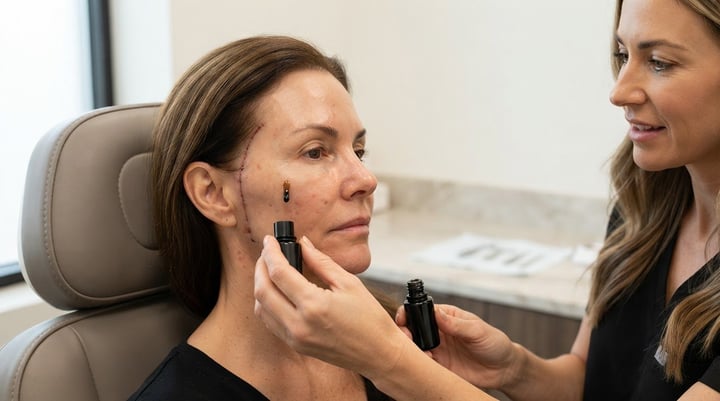
For established scars, treatment depends on the scar’s appearance and symptoms. Raised, red, or symptomatic scars at 3-12 months after a facelift may be treated with intralesional triamcinolone and Vbeam. In established scar treatment, Vbeam sessions may be spaced every 4-6 weeks. If a scar doesn’t respond adequately to corticosteroid alone, 5-FU may be used with triamcinolone. These are clinical options, not a universal sequence for every incision.
Timing matters for laser treatment. Vbeam pulsed dye laser treatment may start 4-6 weeks after a facelift, while established scars may need repeated sessions. The purpose is to address scar characteristics, such as redness, not to replace structural surgery. A raised incision and an uneven facial contour are different concerns, so the appropriate technique depends on what is being treated.
Complementary facial rejuvenation treatments can address concerns surgery doesn’t, such as skin quality or scar appearance. The useful distinction is between a structural change and a surface-level goal. For instance, a persistent neck concern may call for a different surgical plan than redness along an incision. Matching each treatment to its target helps prevent one procedure from being expected to correct unrelated areas.
A balanced assessment considers the lower face, jawline, midface, temples, outer brow, neck, and incision sites. This broader view can reveal why a result appears incomplete and whether the concern involves tissue position, untreated facial areas, or a scar that needs separate care.
Earlobe and tragus distortion
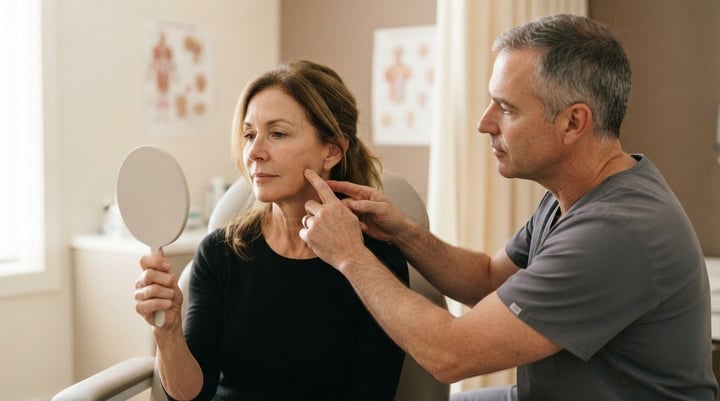
The earlobe and tragus are small landmarks that can make facelift changes noticeable. Their position helps define the ear’s outline, so a changed attachment or contour can draw attention even when the broader facial result looks smooth. Considering these landmarks during a facelift assessment helps distinguish skin tension from changes in surrounding tissue and facial anatomy.
The earlobe’s lower edge meets the cheek, while the tragus sits at the entrance to the ear. These structures provide visible reference points after a procedure. For example, an earlobe that appears pulled downward or attached differently may make the cheek-to-ear transition look altered. Tension near the tragus can also change how the front edge of the ear appears. That observation alone doesn’t identify the cause: incision tension, tissue position, and healing all matter.
Skin-only tightening can place more of the lift’s force on the skin around the ear. If deeper tissue hasn’t been repositioned, pulling the skin toward the ears may affect nearby contours as well as the incision. Excess skin bunching behind the ears can also contribute to more noticeable scars. These factors make the ear worth examining alongside the jawline, rather than treating its appearance as an isolated detail.
A deep plane facelift repositions deeper facial tissue instead of depending on taut skin to create the lift. The aim is to support facial contours while allowing the skin to settle over repositioned tissue. When assessing ear shape, the surgeon considers both sides, the earlobe attachment, the tragus, and the skin behind each ear. Comparing these landmarks helps distinguish changes in tissue position from visible scar tension.
Healing can affect how the ear and incision look over time. Facelift scars generally mature within 3 to 6 months after surgery and continue changing for up to a year. A temporary difference in firmness or scar visibility should therefore be considered alongside the recovery stage. Scar appearance, ear contour, and the original anatomy each offer useful context when reviewing outcomes.
Revision planning depends on the concern being addressed, such as a visible scar or a persistent change in ear contour. A revision facelift is generally delayed until at least 12 months after primary facelift surgery, allowing the initial result and scars time to mature. That timing helps distinguish ongoing healing from a lasting structural concern. The distinction matters: a scar-focused treatment and a procedure to adjust facial tissue position address different issues.
Longevity of facelift results
Facelift longevity depends more on how deeper facial tissues are repositioned and supported than on incision length. Results from skin-tension techniques may relapse as tension relaxes over 1-3 years, while deep plane facelift results are described as lasting 10-15 years. Complication rates cannot be inferred from longevity figures alone; they measure different outcomes.
The distinction is structural. Skin-only lifting relies heavily on tightened skin, while a deep-plane approach repositions deeper facial tissue. As skin tension eases, a lift that depended on that tension may lose definition. A shorter incision doesn’t automatically produce a longer-lasting result, and a longer incision doesn’t guarantee a stronger lift. The more useful question is how the surgical plan supports the tissues beneath the skin.
Consider the jawline. If skin is pulled toward the ears without enough deeper support, the contour may soften as that pull relaxes. The earlobe and area behind the ears can also show how lifting forces affect nearby tissue. Incision length alone can’t explain these changes. The direction of movement and the structures repositioned help clarify why one result may hold its shape longer than another.
Healing follows a separate timeline from lift durability. During days 1-7, incision lines may be raised and pink. In weeks 2-6, scars can become firm and red; during months 1-3, they begin flattening and fading. Incisions generally mature within 3 to 6 months and continue changing for up to a year. These stages describe scar healing, not how long facial contours will remain lifted.
That distinction helps set expectations. A scar that is still changing during its first year doesn’t, by itself, show whether the lift is lasting. Likewise, a smoother scar doesn’t indicate how well deeper tissues are supported. Plastic surgery results should be assessed by both the visible incision and the position of facial tissues over time. Sun protection and skin hydration remain part of scar care for a full year after surgery.
When reviewing long-term outcomes, focus on the method of lifting, the facial areas addressed, and the relationship between the skin and deeper support. Those factors offer more insight than incision length alone. For a personalized discussion of how these principles relate to your goals, explore facelift longevity considerations.
Skin-tension techniques may relapse as tension eases, while deep-plane results are described as lasting 10-15 years. Complication rates are a separate outcome and cannot be inferred from these longevity estimates.
Dr. Daria Hamrah: Deep Plane Facelift (Longevity Facelift)
Dr. Daria Hamrah offers the Deep Plane Facelift, also called the Longevity Facelift, for people considering facial rejuvenation through deeper tissue repositioning rather than skin tightening alone. It may be a relevant option if you’re weighing how a facelift could address facial contours, skin tension, and scar placement together.
A consultation can clarify which areas matter to you, how your facial structure and healing history inform planning, and what to expect from the procedure and recovery. The goal is an informed discussion of your concerns and an approach suited to them, not a promise of a particular result.
If you’re considering a deep plane facelift, contact Dr. Daria Hamrah to discuss your goals.
Make your next decision with clarity
Understanding why skin-only facelifts fail and create stretched scars can shape the questions you bring to a surgical conversation. Rather than focusing only on how tight the skin may look, consider how the plan accounts for facial structure, incision placement, healing, and the result you hope to maintain. A thoughtful discussion can connect those priorities to a suitable approach, without treating one technique as right for everyone.
Before deciding, identify what you want to improve and preserve, such as a natural transition around the ears or balanced facial contours. Share any concerns about scars or previous healing so they can inform the discussion. Clear priorities make it easier to understand the reasoning behind a proposed plan and what recovery may involve.
If you’re ready to discuss your goals and questions, contact Dr. Daria Hamrah. An informed next step can help you move forward with greater confidence and a plan grounded in your priorities.
Frequently Asked Questions
Can a bad facelift be corrected?
Some facelift concerns can be addressed with scar treatment or revision surgery, depending on whether the issue is a scar, contour, or tissue position. These are different problems and call for different approaches. Revision facelift surgery is generally delayed until at least 12 months after the original procedure, giving tissues time to settle. A concern that persists after healing can then be assessed in the context of the original result and the desired change.
What About Bad Scarring?
Noticeable facelift scars can sometimes improve with time, scar-directed treatment, or surgical revision. The right approach depends on whether the scar is raised, red, widened, or causing symptoms. Protecting healing incision lines from direct sun and keeping skin hydrated are useful parts of scar care during the first year. A scar that is still changing differs from a mature scar, so its healing stage helps guide treatment decisions.
What causes a facelift to look unnatural?
A facelift can look unnatural when the skin appears overly pulled, facial contours look unbalanced, or the hairline and ears change shape. An example is a tightened jawline paired with untreated heaviness in another facial area. A natural appearance depends on how the underlying tissues are repositioned and how the skin settles over them. The intended result should respect the person’s facial structure rather than create uniform tightness.
What dictates scar visibility?
Scar visibility depends on incision placement, tension during closure, hair loss near the incision, and the body’s healing response. For example, an incision in a hair-bearing area may look wider if hair loss exposes more of the line. Scars also change during healing, so their color and firmness at one stage may not reflect their later appearance. Health conditions, family history, and individual skin characteristics can influence healing independently of surgical technique.
Why can a skin-only facelift produce an unnatural or short-lived result?
A skin-only lift relies on the skin to create facial elevation without repositioning deeper structures. That can make the surface look pulled while leaving deeper contours less supported. As the skin tension relaxes, results from skin-tension techniques may relapse over 1-3 years. By contrast, facelift longevity depends more on how deeper facial tissues are repositioned and supported than on incision length alone.
How does excessive tension on the skin cause wide, stretched, or displaced facelift scars?
Excessive tension pulls against healing incision edges, which can cause them to drift, spread, or thicken early after surgery. The direction of force matters: an incision near the ear may be strained as skin is pulled toward that area. Conservative skin removal helps the wound edges meet without forceful tightening. Bunching behind the ears can also make the resulting scar more noticeable.
What factors increase the risk of poor facelift scars, including smoking, skin type, and healing problems?
Smoking and sun exposure can impair wound healing and affect scar appearance. Health conditions, family history, and individual skin characteristics may also contribute to less ideal healing, even when surgical technique is considered. For instance, two people with similar incision placement may heal differently because their biological responses differ. Protecting healing scars from direct sunlight and following a consistent care plan help address these influences.
What treatments can improve stretched or hypertrophic facelift scars, and when are they appropriate?
Options include observation as the scar matures, laser treatment, steroid injections, and surgical revision. Raised, red, or symptomatic scars at 3-12 months after a facelift may be treated with intralesional triamcinolone and Vbeam; Vbeam sessions during established scar treatment may be spaced 4-6 weeks apart. For scars that don’t respond adequately to corticosteroid alone, 5-FU may be combined with triamcinolone. Surgical scar revision is considered for mature scars at 12 months or later.