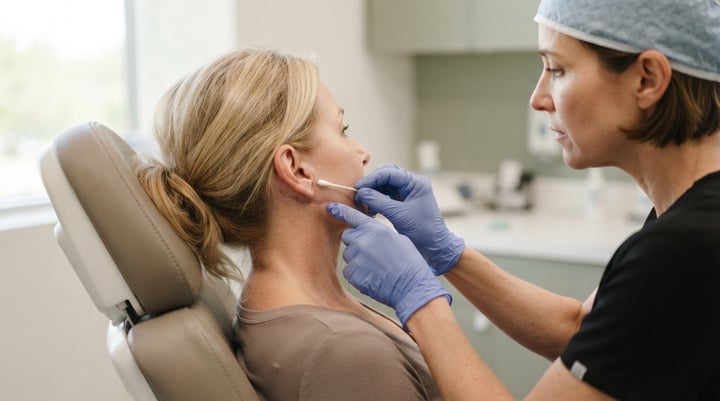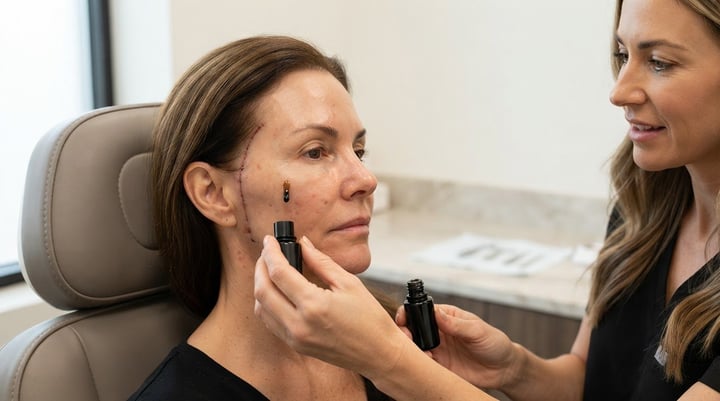

The incision that stays out of sight isn’t automatically the right choice for every lower eyelid. In transconjunctival blepharoplasty, the surgeon reaches the lower eyelid’s fat through an incision inside the eyelid, so there’s no external skin incision or scar. This approach can address fat-related under-eye bags, but it doesn’t remove excess skin.
If you’re considering an internal incision, it helps to understand what this approach can and cannot address. The right plan depends on more than incision location: skin quality, eyelid tone and laxity, fat position, and your goals all matter. An external incision may be considered when loose skin or wrinkles also need attention.
This guide explains how internal and external approaches differ, how surgeons may remove, preserve, or reposition fat, and which anatomical features help determine the right fit. The decision is less about choosing the least visible incision and more about matching the technique to the structures that need attention.
Key Takeaways
- Match the incision to what needs treatment: an internal approach reaches lower-eyelid fat, while an external approach can also address excess skin.
- Fat can be removed, preserved, or repositioned; each option shapes how fullness and the under-eye contour are addressed.
- Skin quality, eyelid tone, laxity, and fat position all inform which surgical approach may fit your anatomy and goals.
- Understanding the procedure’s access route and possible trade-offs can help you have a more informed conversation about lower eyelid surgery.
- A tailored surgical assessment can connect your concerns with an approach designed around your eyelid structure.
Internal conjunctival incision and absence of external scars
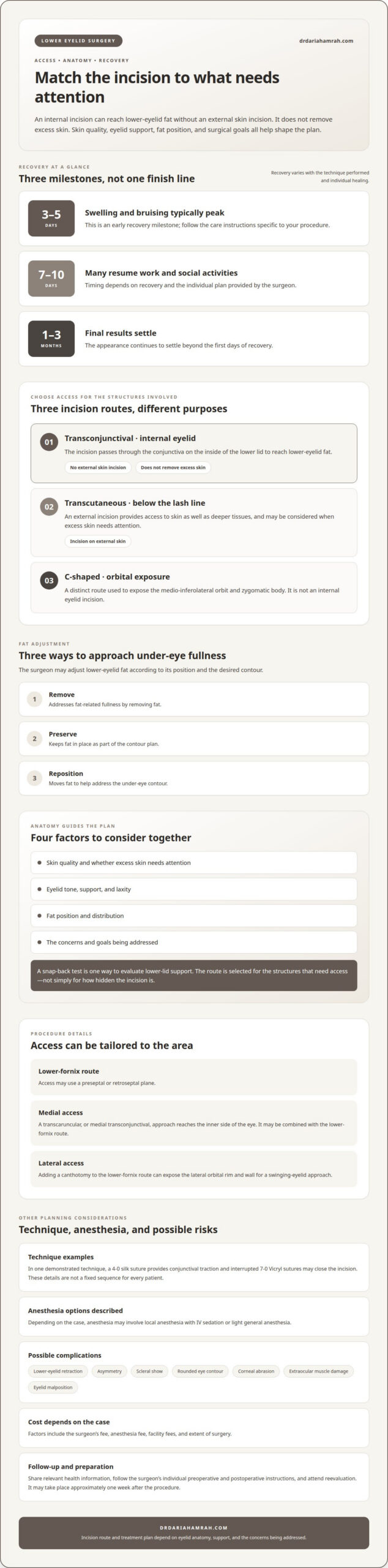
In transconjunctival blepharoplasty, the incision passes through the conjunctiva, the tissue lining the inside of the lower eyelid. This gives access to lower-eyelid fat without cutting the external skin beneath the lashes. Because the incision remains inside the lid, it leaves no external skin scar. The distinction is the incision’s location, not a promise that every concern around the eyes can be treated through the same route.
The internal technique gives the surgeon access to the fat pads behind the lower eyelid. The incision is made on the inner surface of the lid, avoiding a skin incision beneath the lash line. This approach is often considered when bulging fat is the main concern and the lower-lid skin does not need removal. By itself, it does not remove excess skin.
A transcutaneous approach follows a different path, with an external incision just below the lower lash line. This route can provide access to skin as well as deeper tissues, which matters when excess skin needs attention. The approaches therefore differ both in incision location and in what the surgeon can address through that opening. Lower-eyelid muscle tone and skin laxity also help guide the choice.
A C-shaped incision is another access route, used to expose the medio-inferolateral orbit and zygomatic body. It differs from the lower-fornix incision made inside the eyelid. The planned exposure determines which route is useful: the surgeon selects an incision based on the structures that need access, not solely on whether it is visible externally.
| Approach | Incision location | Access or consideration | External skin scar |
|---|---|---|---|
| Transconjunctival | Inside the lower eyelid | Access to lower-eyelid fat | No external incision |
| Transcutaneous | Below the lower lash line | Access that can address excess skin | Incision on external skin |
| C-shaped | C-shaped orbital incision | Exposure of the medio-inferolateral orbit and zygomatic body | Not an internal eyelid incision |
In practical terms, the surgeon first determines whether the concern is fat, loose skin, or both. An internal incision can reach fat without an external lower-lid incision; a lash-line incision provides access when skin treatment is needed. A C-shaped incision serves a different purpose and should not be confused with the internal eyelid route.
Incision choice also informs the recovery discussion, but it is only one part of the surgical plan. The tissues treated, eyelid support, and whether skin is addressed all matter. Avoiding a skin incision, for example, does not mean the procedure treats skin laxity. Matching the route to the anatomy keeps the plan focused on the structures that need correction.
What is Transconjunctival Blepharoplasty?
Transconjunctival blepharoplasty is lower eyelid surgery that reaches the fat through an incision inside the eyelid. The surgeon assesses the eyelid’s position, muscle support, and fat distribution before selecting an access route. This approach targets lower-eyelid fat, not excess skin. That distinction matters when planning a balanced contour.
Access may follow the lower fornix, the inner fold of the lower eyelid. Along this route, the surgeon may use a preseptal or retroseptal plane. A transcaruncular approach, also called the medial transconjunctival approach, provides access to the inner side of the eye. Combining lower-fornix and medial routes expands exposure to both areas.
For lateral access, adding a canthotomy to the lower-fornix route exposes the lateral orbital rim and wall. This extension is relevant to a swinging-eyelid approach, when access needs to reach beyond the lower eyelid. The route depends on which structures require exposure. A limited approach may not provide the same access as a skin incision or an extended route.
During the procedure, the surgeon creates the internal incision and reaches the fat pads for adjustment. In a demonstrated technique, a 4-0 silk suture provides traction on the conjunctiva. The incision may be closed with interrupted 7-0 Vicryl sutures. These details describe one technique, not a fixed sequence for every patient.
Possible complications include lower-eyelid retraction, asymmetry, scleral show, and a rounded eye contour. Transconjunctival approaches can also carry risks such as corneal abrasion, extraocular muscle damage, or eyelid malposition. Assessing laxity helps guide the approach; a snap-back test is one way to evaluate lower-lid support.
The cost depends on the case and is provided after a quote request; factors include the surgeon’s fee, anesthesia fee, facility fees, and extent of surgery.
The process generally involves assessing eyelid anatomy, choosing an access route, adjusting fat, and closing the incision. Depending on the case, anesthesia may involve local anesthesia with IV sedation or light general anesthesia. Swelling and bruising typically peak during the first three to five days. Most patients resume work and social activities within seven to ten days, while final results settle over one to three months.
Before surgery, share relevant health information and follow your surgeon’s individual preoperative instructions. Afterward, follow the specific care plan and attend your reevaluation, which may take place approximately one week after the procedure. Recovery guidance should reflect the technique performed and your healing.
In the United States, patients can assess a surgeon’s qualifications by reviewing board-certification credentials and experience with lower eyelid approaches. A useful consultation explains the proposed incision, fat plan, eyelid-support assessment, and relevant risks. A lower eyelid surgery assessment can help connect these considerations to your anatomy and goals.
Fat adjustment and repositioning
Lower blepharoplasty can address under-eye bags caused by herniated fat pads. Depending on the visible fullness and desired contour, the surgical plan may remove, preserve, or reposition fat.
Fat Sculpting and Repositioning
Repositioning moves existing lower-eyelid fat rather than simply removing it. This can soften a pronounced transition between a bulging area and a hollow contour. Preserving fat also helps maintain youthful fullness and reduce the chance of an overly hollow appearance. The aim is a considered adjustment, not maximal fat reduction.
For example, a patient may have a distinct fat bulge beside a depression. In that situation, repositioning can redistribute some existing volume to create a smoother transition. The decision depends on where the fat sits and how much volume the surrounding area needs. Unlike repositioning, removal reduces the amount of fat rather than relocating it.
Repositioning has trade-offs. Sutures used to secure the fat and changes to its blood supply can contribute to visible swelling. The surgeon weighs that possibility against the contour benefit, taking into account the fat’s position and surrounding tissue. The goal is to improve the balance between fullness and hollowing while retaining enough volume for a natural-looking lower eyelid.
Fat Adjustment and Removal
Fat removal reduces protruding volume when herniated pads create visible under-eye bags. Unlike repositioning, removed fat no longer contributes to the lower-eyelid contour. The choice is not simply “more” or “less” correction: removing too much can create a hollowed appearance, while preserving or moving fat may better suit a contour with nearby volume loss.
During planning, the surgeon assesses the location and amount of bulging fat, then considers whether reduction, preservation, or redistribution best suits the anatomy. For a prominent bulge without a nearby hollow, conservative removal may address excess volume. If a hollow is also present, preserving or repositioning fat may support a more balanced contour.
These options can be combined as tailored adjustments rather than treated as rigid, separate procedures. One fat pad may need reduction while another area benefits from preservation or repositioning. The plan depends on the pattern of fullness, lower-eyelid structure, and desired appearance. Surgical expertise matters because even small changes in fat volume can alter the eye area’s contour.
To compare the options, consider the main concern: isolated excess points toward reduction, while a bulge beside a hollow may favor preservation or repositioning. The surgeon’s assessment connects that visible pattern with the safest, most coherent fat plan for lower blepharoplasty.
Choosing an approach based on anatomy, goals, and surgeon expertise
The right eyelid surgery method depends on what is causing the concern. A surgeon considers fat position, skin quality, muscle tone, lower-lid laxity, and your goals. For eye bags with good skin elasticity and little excess skin, an internal approach may be suitable. Loose skin or prominent wrinkles may call for an external approach that can address skin directly.
How does transconjunctival blepharoplasty compare with external lower blepharoplasty? The internal method reaches fat through the lower eyelid, leaving no external skin incision, but it cannot remove excess skin. The external method uses an incision below the lashes and may suit patients who need skin tightening, although temporary eyelid-position changes during healing are slightly more likely.
| Approach | Useful exposure | Anatomical consideration | Potential limitation |
|---|---|---|---|
| Lower-fornix transconjunctival | Lower-eyelid fat and orbital floor | Good skin elasticity, fat herniation | Does not remove excess skin |
| Preseptal or retroseptal route | Access through the lower fornix | Surgeon selects the tissue plane | Access depends on the planned procedure |
| Transcaruncular route | Medial orbital access | Addresses the inner orbital area | Does not provide skin tightening |
| Lower-fornix route with canthotomy | Lateral orbital rim and wall | Used when lateral exposure is needed | Extends beyond a limited internal route |
| Transcutaneous | Lower eyelid skin and deeper tissues | May suit skin laxity or wrinkles | Incision lies below the lash line |
The surgeon connects these anatomical findings to the intended contour. A snap-back test helps assess lower-eyelid laxity, while skin quality and muscle tone inform how much support the lid needs. The surgeon also considers whether the main concern is fat alone or a combination of fat and loose skin. These findings guide both the access route and the extent of correction.
Expertise matters when matching access to the structures being treated. A limited internal approach may suit isolated fat herniation, while additional access may be considered for medial or lateral areas. Each extension changes the surgical route; it is not simply a more comprehensive version of the same incision. The surgeon should explain why the proposed method fits your anatomy and goals.
Risks also inform the decision. Lower-lid surgery can cause retraction, asymmetry, scleral show, or changes in eye shape if the technique or execution is unsuitable. Transcutaneous surgery may involve a slightly longer recovery than the internal method. The practical choice is to match the incision to the concern: fat with firm skin, skin laxity, or a need for wider orbital exposure.
The choice also depends on skin quality, fat position and amount, muscle tone, and eyelid anatomy. Transcutaneous surgery may suit substantial skin laxity or significant lower-eyelid wrinkles that require skin tightening; transconjunctival surgery generally suits fat herniation without significant excess skin.
What is transconjunctival blepharoplasty and its process?
This lower-eyelid procedure accesses fat through an incision inside the eyelid. In the United States, surgery typically takes approximately one to two hours. The surgeon evaluates fat position, eyelid support, and skin laxity, then plans the access route and fat adjustment. Since this approach does not remove excess skin, the plan focuses on concerns the internal route can address.
Anesthesia depends on the case. Transconjunctival blepharoplasty may be performed under local anesthesia with IV sedation or light general anesthesia. Once the patient is prepared, the surgeon exposes the inner lower eyelid and makes an incision through the conjunctiva. Corneal shields can protect the eye during surgery. The chosen route and safeguards are part of the operative plan.
After access is established, the surgeon examines the lower-eyelid fat pads and adjusts them according to the intended contour. Fat can be reduced, preserved, or repositioned, depending on the pattern of fullness and nearby hollows. In a described technique, a 4-0 silk suture provides traction on the conjunctiva. This is a technical example, not a required step in every case.
Closure also depends on the approach. One described method closes the conjunctival incision with interrupted 7-0 Vicryl sutures. There are no external skin stitches with an internal incision. The procedure involves delicate structures, so possible complications include eyelid malposition, corneal abrasion, or extraocular muscle damage. Protecting the eye and preserving lower-lid support remain important considerations during the operation.
Recovery unfolds over several stages. Swelling and bruising typically peak during the first three to five days. Some patients return to light, low-visibility activities five to seven days after surgery, while most resume work and social activities within seven to ten days. Visible bruising and swelling typically resolve within two weeks. Residual swelling can continue to fade as results settle over one to three months.
Follow the individualized postoperative instructions provided for the procedure, and attend the planned follow-up. Reevaluation occurs approximately one week after surgery in the described care pathway. Healing varies with the procedure and the patient’s tissues, so the care plan guides activity and follow-up. If you’re considering transconjunctival blepharoplasty, discuss your lower eyelid surgery plan in a consultation.
Dr. Daria Hamrah: Blepharoplasty
Dr. Daria Hamrah offers blepharoplasty for people considering changes to their lower eyelids. If under-eye bags, skin laxity, or eyelid contour are concerns, a surgical assessment can help determine which approach fits your anatomy and goals. You can discuss whether an internal incision is appropriate, how fat may be adjusted, and whether excess skin also needs attention. Understanding these details can help you weigh the procedure’s purpose and trade-offs before deciding on surgery. Dr. Hamrah is a board-certified facial cosmetic surgeon, and her practice includes blepharoplasty as part of facial rejuvenation care. To discuss your lower-eyelid concerns and possible surgical options, contact Dr. Daria Hamrah.
Take the Next Step With Clarity
A thoughtful decision starts with defining what you want to change and what you want to preserve. Before considering transconjunctival blepharoplasty, reflect on which concerns matter most, what kind of change feels right, and how recovery may fit into your life. These priorities can focus your surgical conversation and help you discuss personal trade-offs rather than choosing an incision based on appearance alone.
If transconjunctival blepharoplasty is on your mind, use a consultation to explore how the proposed plan relates to your anatomy and goals. Ask about expected changes, potential risks, and the reasoning behind the recommended approach. Contact Dr. Daria Hamrah to discuss your lower-eyelid concerns and possible next steps. An informed decision is a meaningful step toward care that feels right for you.
Frequently Asked Questions
How is the procedure done?
In transconjunctival blepharoplasty, the surgeon accesses lower-eyelid fat through an incision inside the eyelid, adjusts the fat, and closes the incision. The procedure typically takes approximately one to two hours. Depending on the case, anesthesia may be local with IV sedation or light general anesthesia. Swelling and bruising generally peak during the first three to five days, while recovery continues as residual swelling fades.
Who is a good candidate for transconjunctival lower eyelid surgery?
People with under-eye bags from herniated fat, good skin elasticity, and good lower-eyelid muscle tone may be candidates, particularly when excess skin is not a main concern. A surgeon also evaluates lower-lid laxity, including with a snap-back test, and considers fat position and eyelid anatomy. Substantial loose skin or wrinkles, for example, may point toward an approach that can address skin as well.
What conditions can this internal eyelid approach treat, and what can’t it correct?
This surgery addresses under-eye bags caused by herniated lower-eyelid fat. The surgeon may remove, preserve, or reposition fat to refine the contour. The internal approach does not remove excess skin, so it cannot correct loose skin by itself. Creams also cannot treat bags caused by herniated fat. If skin laxity or wrinkles are central concerns, they need to be included in the surgical plan.
What are the risks and possible complications of transconjunctival lower eyelid surgery?
Possible complications include eyelid malposition, lower-lid retraction, asymmetry, scleral show, and a rounded eye appearance. The internal approach can also cause corneal abrasion or extraocular muscle damage. These risks make eyelid support and anatomy important parts of surgical planning. A useful discussion covers the planned access route, how the lower lid will be supported, and which risks relate to your procedure.
How long do results last, and what results can patients expect?
The expected change is a refined lower-eyelid contour where herniated fat created visible bags. Final results settle over one to three months as residual swelling fades. The outcome reflects the chosen fat adjustment, whether removal, preservation, or repositioning. The procedure changes existing eyelid tissues; it does not stop natural aging. Discussing your goals helps clarify what changes are realistic for your anatomy and concerns.